
Georgetown County Arrest Records and Charges
Georgetown County arrest records begin with law enforcement. The sheriff booking and release roster can show a mugshot, name, sex, age, date of birth, release date, booking date, arresting agency, charges, and bond where posted. The arrest record is not the same as the final criminal court file. It is the custody and booking side of the event, often created before the prosecution record is complete.
Court charges after arrest are tracked through the court process. A prosecutor, called a Solicitor in South Carolina, handles General Sessions prosecutions. Magistrate and Municipal Courts can also handle summary and local criminal charges. Once filed, the charge record may show a charge name, court, case number, bond entry, hearing, disposition, dismissal, plea, sentence, or later expungement status. The full outcome belongs in Georgetown County criminal court records, while jail custody and roster details belong with inmate records.
The sheriff source appears on the Georgetown County government Sheriff's Office page.
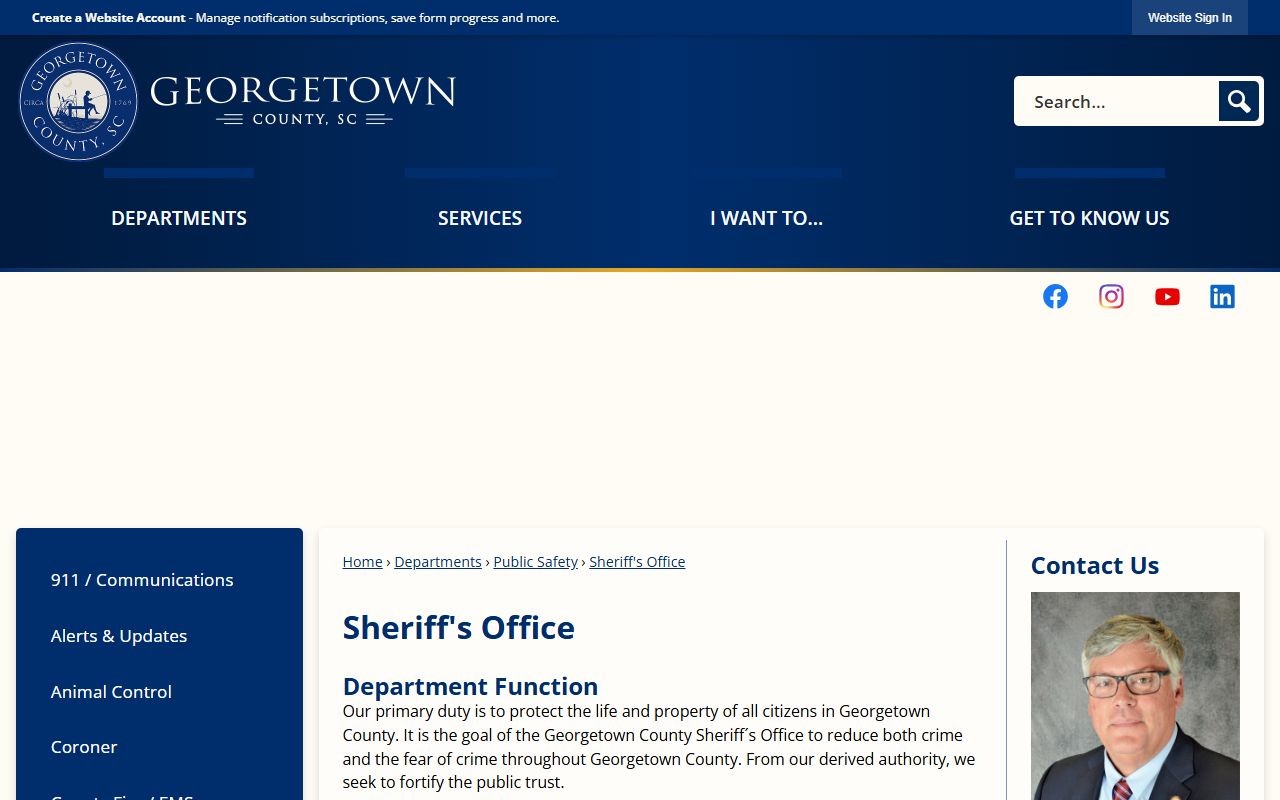
The Sheriff's Office page is relevant because arrest records start with law enforcement before court charges are filed and resolved.
Find Georgetown County Arrest Records
The first custody source is the Georgetown Sheriff Booking and Release page. The sheriff FAQ says a person can search an inmate by last name, arrest date, or release date. The roster is useful for recent arrest and booking information, but charges and bonds may lag because the sheriff FAQ says charges are not posted until warrants are served and bonds are not posted until Bond Court submits paperwork to the Booking Officer.
- Search the sheriff booking and release roster by last name, booking date, or release date.
- Review the booking entry for arresting agency, booking date, listed charge text, and bond when posted.
- Use the Georgetown Public Index to look for the related court case by defendant name or case number.
- Check court rosters for hearing dates and confirm bond or case status with the correct court if the online record is unclear.
- Use sheriff FOIA or county FOIA only for records not available online and not exempt from release.
The official booking roster source is the Sheriff Booking and Release page.

The roster helps bridge arrest records and court charges because it shows booking data before the later court file may be complete.
Charges After Arrest in Georgetown County
Charges after arrest can enter court through different papers and court paths. South Carolina research for Georgetown County names warrants, indictments, prosecutor filings, and summary-court charges as practical sources. The precise label depends on the court and offense. A General Sessions felony may involve an indictment or prosecutor action. A Magistrate or Municipal matter may start through a warrant, ticket, complaint, or summary charge.
| Charging Document | Filed By or Issued By | Common Use |
|---|---|---|
| Complaint / Ticket / Summary Charge | Officer, agency, or summary court process | Traffic, ordinance, and lower-level criminal matters. |
| Information / Prosecutor Filing | Solicitor or prosecutor | Charges moved into the prosecution file where allowed by process. |
| Indictment | Grand jury process | Serious criminal charges in higher court. |
| Arrest or Bench Warrant | Magistrate or judge | Arrest, failure to appear, contempt, or warrant-based court action. |
Georgetown County Bond Court Charges
Bond Court is a key point between arrest records and court charge records. Georgetown County Bond Court is held at the Detention Center. The sheriff Bond Court page states that bond hearings are the responsibility of the courts that hold them. The detention center does not initiate proceedings, accept money for bonds, decide dispositions, or decide release dates. After the scheduled bond hearing, the GCDC website should be checked for charge and bond information.
| Court | Days / Times | Covered Agencies |
|---|---|---|
| County Bond Court | 7 days a week at 9 a.m. and 3 p.m. | Georgetown County Sheriff's Office, 15th Circuit Drug Enforcement Unit, SCHP, SCDNR, and other state agencies. |
| Georgetown Municipal Bond Court | 7 days a week at 11 a.m. | Georgetown Police Department charges only. |
| Andrews Municipal Bond Court | 7 days a week at 10:30 a.m. and 2 p.m. | Andrews Police Department charges only. |
The Bond Court source is the Georgetown Bond Court page.
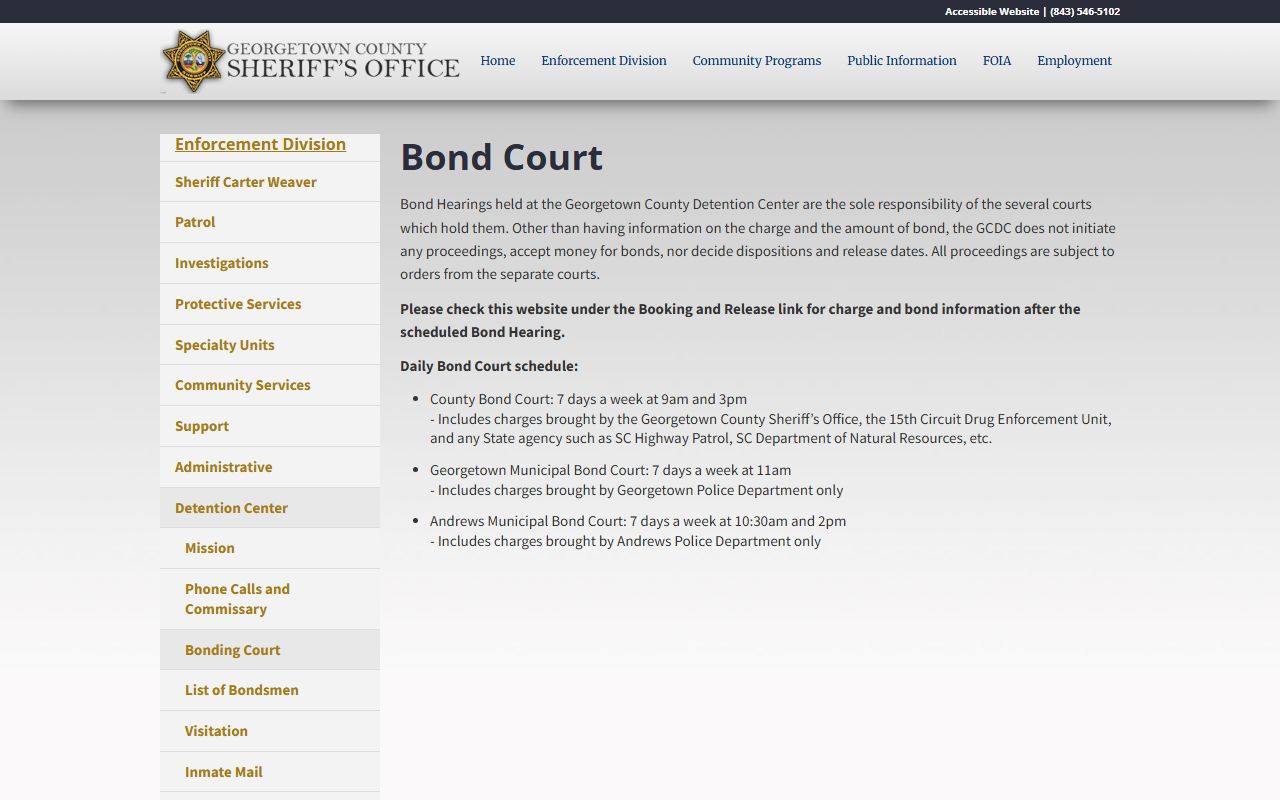
Bond Court timing helps explain why a booking entry may not show bond data as soon as the arrest record appears.
Georgetown County Charge Status
A charge can change after the first booking entry. It may be pending, amended, reduced, dismissed, nolle prossed, transferred, or resolved by plea or trial. The Georgetown County arrest record may show what was listed at booking. The court charge record shows how the filed accusation moves through the court.
| Status | What It Means |
|---|---|
| Pending | The charge is open and has not reached a final court outcome. |
| Amended / Reduced | The filed charge changed, often to a different offense or lower level. |
| Dismissed | The charge was ended by court action and did not result in conviction. |
| Nolle Prosequi | The prosecutor declined to continue that charge in court. |
| Disposed | The court recorded a final result for that charge or case. |
The detention FAQ source is the Georgetown Detention Center FAQ.
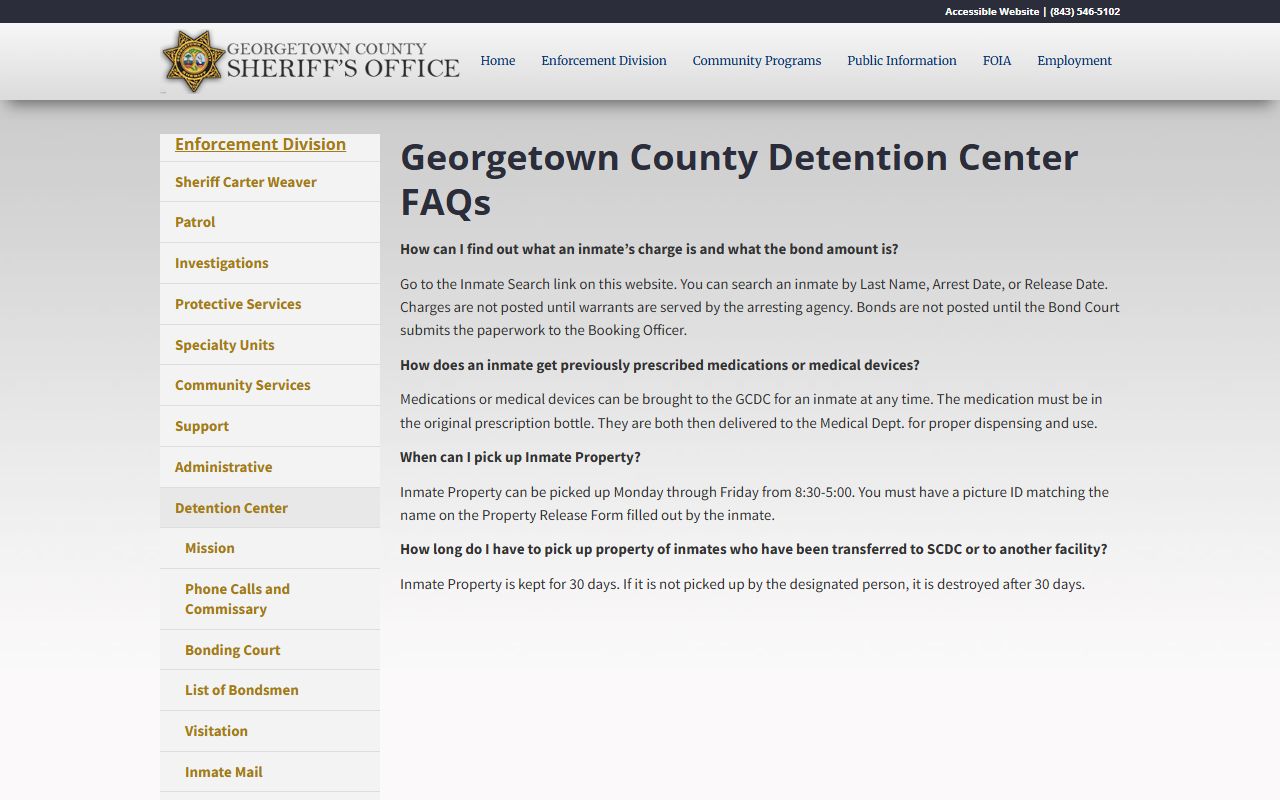
The FAQ is important because it documents the lag between arrest, served warrants, bond paperwork, and public booking display.
Charges vs Convictions
Georgetown County arrest records and court charge records can show accusations. They do not always show guilt. A conviction requires a guilty plea, guilty verdict, or other court finding that establishes guilt. A booking charge may never become the filed charge, and a filed charge may later be dismissed, reduced, or expunged if the person qualifies.
| Point | Charge | Conviction |
|---|---|---|
| Meaning | An accusation after arrest or court filing | A court result establishing guilt |
| Where Seen | Booking roster, warrant, citation, Public Index, docket | Disposition and sentencing entries |
| Can Change | Yes, it may be amended, reduced, dropped, or dismissed | May be appealed or later affected by relief |
| Use With Care | Does not prove guilt | Shows the final criminal outcome unless later changed |
Statewide Criminal History Channels
Not every charge-related search is local. South Carolina sentenced state-prison custody is searched through SCDC, custody notifications can use VINELink, sex offender records use SLED's registry, and federal custody uses the Bureau of Prisons. Those systems do not replace Georgetown County court charge records. They answer different questions about custody, registry status, or federal imprisonment.
For sheriff records not shown online, use the sheriff FOIA process. For judicial records not available through public court systems, use Rule 610. For county administrative records, use Georgetown County NextRequest. These channels have different fees, timing rules, and exemptions.
| Channel | Use | Limit |
|---|---|---|
| Sheriff Booking and Release | Recent booking, release, arresting agency, charges, and bond when posted | Not the final court outcome. |
| Georgetown Public Index | Court charges, docket entries, hearings, and dispositions where available | Requires the right court path and browser settings. |
| SCDC | Sentenced state-prison custody | Does not show all county jail bookings. |
| VINELink | Custody or case notifications | Notification system, not a full court file. |
| SLED Registry | State sex offender registry search | Separate from charge and disposition lookup. |
Note: A statewide custody or registry search is not the same as a Georgetown County court charge record.
Sealed vs Expunged Charge Records
Restricted charge records can disappear from public view for more than one reason. A sealed record is restricted by law or court order. An expunged record is removed from public access after the proper legal process. South Carolina Title 17 includes expungement rules, and qualifying summary-court records can be removed from Internet-based public records after verification and order processing.
| Point | Sealed | Expunged |
|---|---|---|
| Public Access | Hidden or limited | Removed from public access after order |
| How It Happens | Court order, rule, or confidentiality law | Statutory expungement process |
| Examples | Juvenile, Family Court, judge-sealed cases | Qualifying dismissed, summary, or eligible criminal records |
| Wrong Tool | FOIA cannot unseal it | FOIA cannot erase it |
Restricted Georgetown Charge Records
Juvenile charges, sealed cases, certain Family Court matters, and expunged records are restricted. Georgetown Family Court materials exclude adoption, abuse-neglect, termination of parental rights, juvenile matters under age 17, and judge-sealed private cases from public access. Sheriff's FOIA materials also identify body-worn camera data as outside routine FOIA disclosure under the cited state law.
For arrest records, the sheriff roster is the first public source after booking. For the filed charge and later court result, use the court case search, docket search, or the Clerk of Court. For warrant or failure-to-appear questions, the issuing court matters. Magistrate, Municipal, Family, and General Sessions warrants can follow different routes.
Ask for the specific record type when contacting an office. A booking entry, incident report, warrant, bond record, court charge, disposition, sentence, and expungement order are separate records. The right request depends on whether the user needs custody facts, law-enforcement paperwork, the filed accusation, or the court's final result.
Sheriff FOIA and county FOIA also have limits. The sheriff page lists separate fees for reports, staff time, and media, while Georgetown County NextRequest is aimed at county department records. Judicial records should be searched through Public Index, rosters, the Clerk, or Rule 610 before treating FOIA as the best path. That order keeps arrest, charge, and court outcome sources separate.